
You Need To Do It So That You Can Do IT
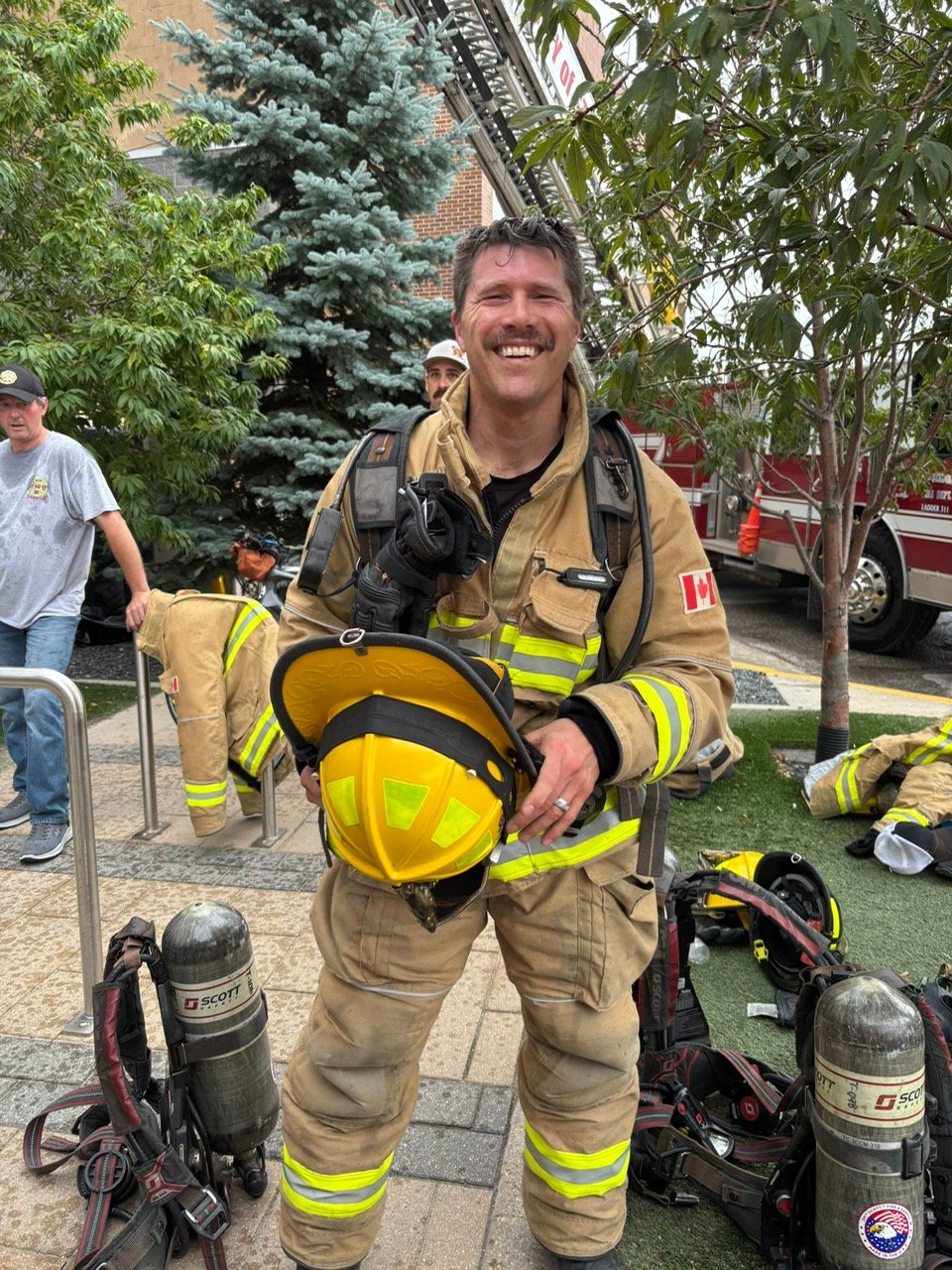
This past September 11th I took part in a local memorial stair climb. Myself along with other emergency service workers went up and down the stairwell of our six story Steinbach Credit Union 7 times (plus 2 extra flights). This represented the task facing firefighters as they walked up the flights of stairs at the twin towers in New York City that day. Some people just did the task of climbing the stairs, others wore some or all of their gear, and some also wore their SCBA and harness which would add about 50-60 pounds of additional weight. Everyone experienced the challenge of pushing through discomfort and the body’s desire to stop. Maybe even the mind as well.
It took me a little over 30 minutes to complete and throughout I kept reminding myself that this is why I often tell people to take the stairs whenever you can. You need to do it so that you can do it.
For what situation are you fit enough?
Do you ever stop and consider what situations your exercising is preparing you for? It is common for people to think about short-term and personal goals like reaching and maintaining a certain body weight, having more energy, or feeling strong enough to do the physical tasks needed in the day. But what about being fit enough for an unplanned event?
Exercising only for daily activity checks a box, but where motivation is concerned I find if someone has a target or purpose to their exercise efforts that person is more likely to stay consistent and keep showing up. They see their efforts moving in a direction which helps when “feeling like exercising” is lacking.
Most people don’t think about catastrophe preparedness. Since it is unlikely to happen it is not hard to push the thought from mind and assume everything is OK, will continue to be OK, and if something does happen there will be someone else around to solve it. We get to read about catastrophes in other parts of the world so they do happen. And they can happen here too.
Maybe it’s just me, but when I watch a disaster movie or read about someone going through such a disaster, I can’t help but wonder how I would do in that same situation. These are often just regular people who find themselves facing an ordeal.
Being a first responder I know that there will come times when I need to be physically up to the task and I train so I can have confidence that my fitness will meet that task. When on duty or on call, I expect to encounter a physically demanding situation. Going a bit deeper, part of my motivation is to reduce the odds of me being a liability to my crew and should I need to rescue a fellow firefighter I have taken steps to be prepared for just that. I am not only fit for myself but those around me.
When I think as a civilian, I wonder whether there is an assumption or just naivete that I won’t need to be fit for an unexpected event. Do we even consider a responsibility to be fit for our fellow civilians?
What would happen if a civilian seriously considered being fit enough for the “what if?”
For those occupations in which we hold an expectation of fitness, there will be a test to pass. And often periodic re-tests to maintain the standard. Are you fit enough to pass a firefighter fitness test like the CPAT, or the RCMP PARE test? Or how about an army fitness test like our own Canadian Forces FORCE evaluation? The descriptions are accessible and testing ourselves against them 1-2 times each year can not only give us a motivational reason to train, this can also give us a benchmark to compare our work capacity over time.
Plus, doing so can help answer a question: could I be confident I have the capability if called upon?
The CPAT and PARE have some equipment requirements but often university athletic departments offer testing at various points during the year. One could invest in an annual test. We have run mock PARE and FORCE tests at our gym numerous times.
The FORCE evaluation is more easily done at home with several sandbags, a wall and a bit of space. A bag of rock salt is about the same weight so getting several bags is doable and then you have a supply for your water softener.
You could get a good appraisal of how you measure up or what you can improve upon in less than an hour of your time.
Two thoughts I hope you can take from today’s blog post:
First, always take the stairs when you can. It’s good practice.
Second, extraordinary situations often make extraordinary demands of ordinary people. We accept that responders and soldiers have a responsibility to be fit, in fact we expect it. It would be wise to own our need to be an asset in an emergency instead of a liability.
How would you answer this question: Does a civilian have a responsibility to be fit? If yes, what is the trade-off to do something about it?
-Aaron