How To Work Out (Almost) Every Day
I wanna get physical, sings Olivia Newton-John. I know she has a bit of a different meaning when she says it, but our bodies do have the need to be physical. Our bodies just don’t function as well as they could if we don’t make them work for it.
Years ago, life was much more physical, and it was every day. Most parents strive to make life easier for their children than it was for themselves. So along with the technological advances of the last century the physical demands of life have gotten easier. Yes, we still work hard and often long, just not as physical. Our bodies don’t get the daily kinetic stress of work throughout our lives, until we get to the point that they are working so hard to stay alive from neglect.
Ironic.
Sometimes we add a recreational activity or sport to offset this imbalance. While this can be enjoyable, it doesn’t always provide a balance of or sufficient frequency of activity. And for those who aren’t exactly sporty, there can be a real deficit of physical demand. So we need to create it artificially.
Enter the workout regimen.
Usually people can agree that too much of a good thing isn’t wise. But in the world of exercise more can often be better than less. That’s because the more frequent you workout in the week the more it becomes a part of your lifestyle. It becomes the thing you do. Also, life tends to throw obstacles in the way, so knowing that you are working out 5-6 days of the week, if you wind up missing a session, you still are doing 4-5 workouts. That activity adds up, and in a good way.
Common guidelines suggest we need 150 as a minimum to 300 minutes each week of physical activity. We also need to incorporate resistance/weight-bearing exercise and a combination of moderate to vigorous intensity level exercise. Guidelines are great but not specific enough. They don’t tell us how to actually make it happen.
A good way to organize training is to look at common human movement patterns and look at different ways to load those movements. Generally speaking, our bodies hip hinge, squat, horizontal & vertical push and pull. We could also consider lunging, rotation/counter-rotation, and weighted carries. These patterns are described in a number of articles by Dan John. We can also do combinations of these movements. Scheduling these across several days of the week gives a person the chance to build up the resistance on a lift in the lower rep ranges (eg. 3-8), enough to cause a training effect without needing to workout for hours each day.
Adding some combinations of movements in the form of circuits and/or intervals will contribute to the moderate-vigorous intensity conditioning work to help build endurance, stamina and cardio/respiratory fitness.
So, how to structure it in a way that covers the bases, is progressive and also makes it fun?
THIS IS HOW WE DO IT
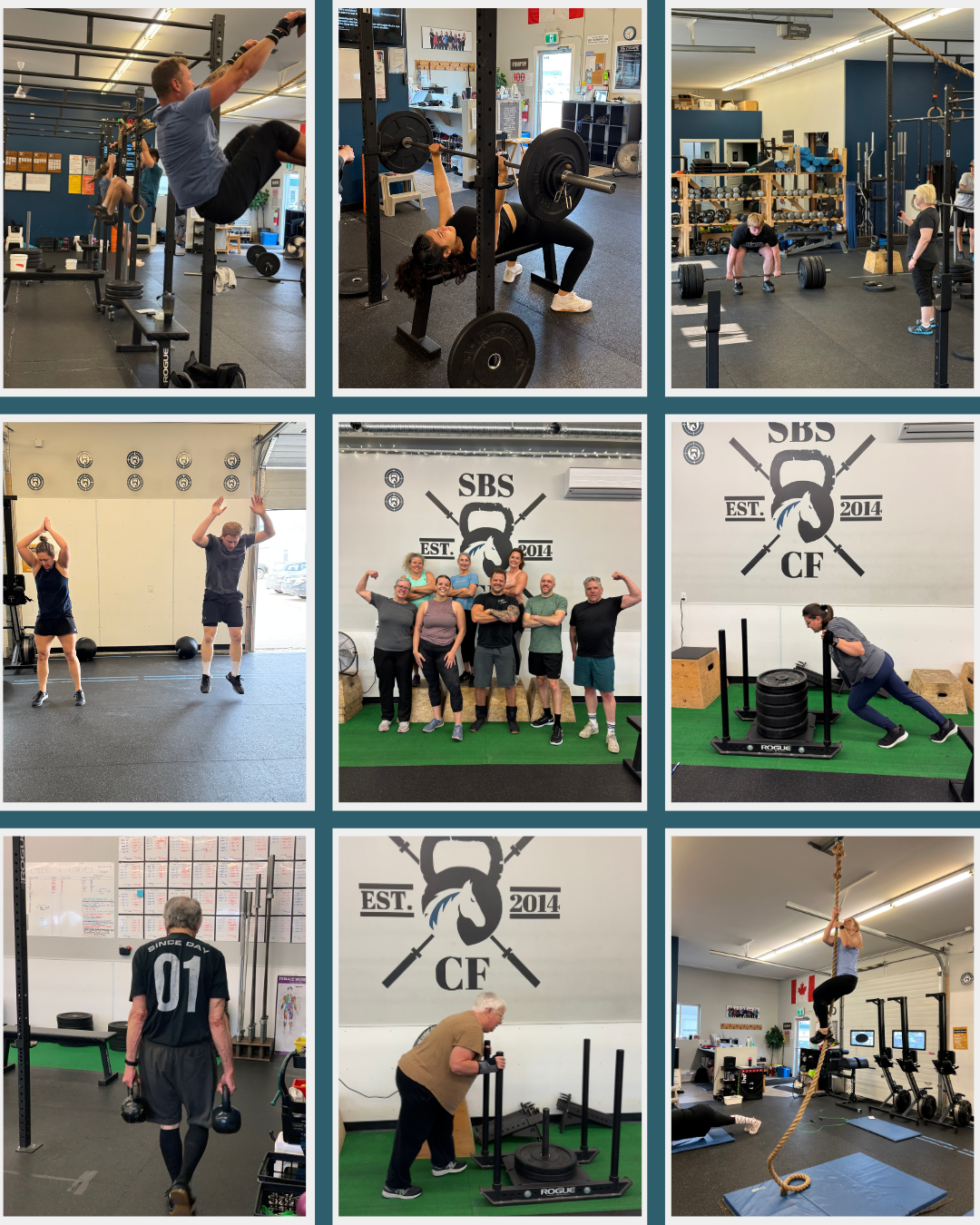
Our general strength and conditioning program at Stone Brook Strength is based on a weekly training template and the more a person shows up the more well-rounded their fitness base becomes. Each week will incorporate all the above mentioned movement patterns in various reps and sets arrangement. Monday could train the barbell row, Tuesday could train the squat, Thursday could train the bench press, Friday could train the deadlift. There is time in a session to build up to a significant weight and then perform a short to moderate length conditioning workout also built around the common movement patterns, except in a way that is lighter and more challenging to the cardio-respiratory system.
Because we have members that may only be able to attend on strictly set days of the week, we rotate the primary lifts across the week so that they are less likely to miss a specific lift for a long time. But the benefit of more frequent attendance is more well-rounded fitness, surprisingly less muscle soreness and better progress overall.
Further to how we program for our gym, we intentionally plan a double day which trains 2 strength movements or allows a member to make-up a missed lift from the week. This is because we believe very strongly in how much of an impact the barbell lifts make in our health and fitness.
Did you notice that Wednesday was missing in the above schedule? Since the majority of days includes a primary barbell lift, the conditioning often tends to be shorter, in the 10-15 minute range. Here is where we get our vigorous intensity work. But, we will also program a longer endurance conditioning day by itself, which will be lower intensity and longer duration. These days are also very important because they help train our stamina for extended physical demands. We also have fun partner workouts on Saturdays but one could also take some weekend time to go for a long walk or other leisure activity with the family, the longer the better!
Does it sound like there are a lot of moving parts? Well, yes, there are. There is a lot of intention that goes into setting up an effective week of training that strives to avoid favoritism and missing weak spots. Plus, our coaches are rock stars in modifying and adapting the session if someone has an issue or restriction they don’t know how to train around and might otherwise skip working out. That’s why we say just show up! We can usually find a way to still get an effective workout and keep your momentum going. The other side of that momentum, The Big MO, is where success waits.
Show up and show up often.
FIVE-THREE-ONE
If you want to develop a level of fitness that will have you stand out among the normies, here is a goal: each week aim to get 5 moderate-to-vigorous conditioning workouts, strength train to a heavy-ish resistance weight 3 times, and get 1 endurance activity session that is 30 to 60 minutes long.
If you have done some of our workouts you know that they can be intense, that is part of what makes them fun for many people. But if we want to train more days we need to be smart about it. In application we are looking to have intentional intensity not maximal intensity, which means that we shouldn’t push ourselves to maximal effort all the time. We need to be intentional with working hard yet also keeping some reserve. There are days we need to prioritize just moving and getting a little winded over pushing ourselves to a red line effort. If you are not vying for a medal or a paycheck with your fitness, you can still do well by sandbagging a few workouts each week (cue the clutching of pearls!). This way you can sustain more frequent training over a long period of time and that is where the true progress is, the kind that has your relatives who haven’t seen you since the last gathering say “Whoa, what have you been doing!?”
We are looking for people who want to make this their thing. We could be the gym for you and you don’t have to figure it all out. Just get in the door and keep coming in that door. With 5 hours each week (that’s only 2% of the hours in the week!) you will easily hit the target activity minutes. Keep it up and you could very well find yourself to be the fittest person in most rooms.