
I feel the need, the need for feed.
Every now and then we have someone in the gym bonking out. Essentially what happens is that during the training session this person hits the wall, runs out of gas. She gets light headed and feels like she has no oomph to give to her lifts. She will often wonder aloud why she can’t seem to perform to her expectation. The first question our coaches will probably ask is, What have you eaten today? More often than not, the answer is nothing.
And it’s not like these folks are trying to intentionally fast while training (though that has been encountered), it is more common that the person just didn’t make the meal happen, and especially realize how important it is to eat.
#ihavenooomphstogive
We live in a calorie-rich environment. Unfortunately, it is often that people will eat more calories than needed for their activity levels. Just because the food is all around us doesn’t mean that everyone pays attention to how much they eat, or even knows the what and how much they need and when.
It is possible for an overweight person to have the perception that they don’t eat very much and also lack the structure of regular eating that will give them balanced energy throughout the day. People may assume they should simply eat less because they want to lose weight, but we can sabotage our body’s efforts at getting stronger and more fit and yes, lose weight, due to insufficient fuel.
The idea of running out of gas is insightful. Think about going on a trip, and how it would seem silly to load up our vehicle with luggage and people and then be surprised that we don’t get very far by neglecting to fill up the tank (or put in the wrong fuel).
Fuel is part of the equation. I have a friend who loads airplanes with cargo. It is not as simple as just packing the stuff in to fit. Factoring the weight of the cargo is crucial because more fuel is required when the performance demand of the airplane increases. To complicate things further, guess what - additional fuel also weighs more, so that detail also needs to be considered. Sufficient fuel is a very big deal. You don’t want to have an airplane bonk mid-flight.
That would be a ride into the danger zone.
But if I have extra bodyfat, doesn’t that mean my body should burn that instead of bonking? Isn’t that the secret to losing weight?
The challenge arises that an out of shape body, even while having extra bodyfat, cannot convert fat to glucose fast enough to power high-intensity exercise, leading to a sudden, severe energy crisis. This can be made even worse if you have insulin resistance. Yes, to lose weight we need to create an overall calorie deficit, just not haphazardly undermining the physical training efforts while we do it. The calories you burn while working out aren’t from the ones that pad your waistline. Your workouts are a great tool to help reach and maintain a healthy body weight and composition, and that tool needs proper fuel to do that.
Your workouts do burn calories, but that is actually a small part of the total daily expenditure. If you're eating about 2500 calories in a day and you generously burn 300 calories in a workout, that is just over 10% of your caloric intake, granting this is a gross oversimplification. Your workouts also build muscle, and that takes calories too.
I know it sounds like a tug of war, we need to lower our calories - that means eating less. But we need to fuel our bodies - that means eating more. Which is it?
Well, both.
Thinking big picture, we should eat an average total calories on a schedule that is consistent and sustainable, and timed so that we can also have the short-term energy for our workout sessions. I say average because it isn’t really possible to hit exact numbers all the time. That average should be a bit under the amount needed to maintain our current stable bodyweight. Stable bodyweight is not reliably gauged day to day, rather week to week. Then we look to make sure we are taking in enough protein (let’s start with .7 grams per pound of target bodyweight) and carbs. Carbs are not evil and, yes, some carbs are better than others. Focus on lots of vegetables and fruit. And ideally whole source single ingredient starchier carbs in portions that are similar to the protein (eg. oats or oatmeal, sweet potatoes, whole grain rice, quinoa). Use the size of the palm of your hand as a guide.
If you workout early in the morning and you can’t eat breakfast or don’t have time to, make sure you have eaten some carbs at last night’s supper so that your muscles are ready to train.
Going back to our earlier road trip analogy, it’s the driver who is responsible to keep an eye on the dashboard gauges. So it is your responsibility to figure out how many calories you need in a day. An app calculator can only point you in the approximate direction, ultimately you need to pay attention to your intake and the effect it has on the scale over a span of 10-14 days. Not the quick feedback loop we would like but it is what it is. Semantics, maybe, but knowing how many calories is helpful to a limited extent because we don’t eat calories, we eat food. So we need to get a grasp of how much of the food we eat meets our needs and goals.
The point of this blog was to get the message across that starving ourselves through our workouts is often counterproductive, even though it sounds like it might bring some quick upfront success. If you are using physical activity to achieve a goal, it might be helpful to see yourself as an athlete.
And athletes pay attention to their training and fueling. You can’t abdicate your ownership of this.
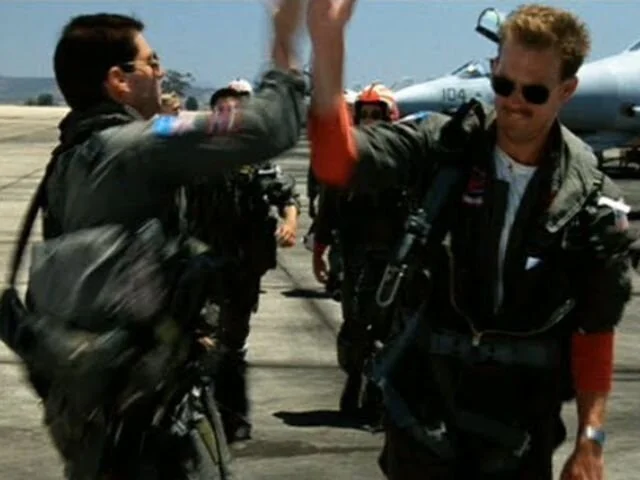
If you want to be a top gun with your fitness, you're going to have to feed and feed smart.
Need help figuring out where to start? Come talk to one of our nutrition coaches, we’ll help get you sorted out and on the right track.